Genetic Design: mRNA Engineering
Sequence-to-function rules for mRNA structure, translation, and stability — and generative models that turn those rules into designs that work the first time.
Why this matters
mRNA is the most programmable layer of biology — the bridge between DNA and what a cell actually does. Yet even today, most engineered mRNAs are still designed by hand, using rules of thumb that break in interesting cases (operons, non-canonical organisms, or therapeutically relevant sequences). We need quantitative, organism-aware design rules and the experimental scale to learn them.
Our PhD work at Ben-Gurion University uncovered a possible universal role for mRNA secondary structure in bacterial translation (Nature Communications, 2020). At MIT we've extended that line of work into high-throughput mapping and generative-model-driven mRNA design across organisms and contexts.
What we work on
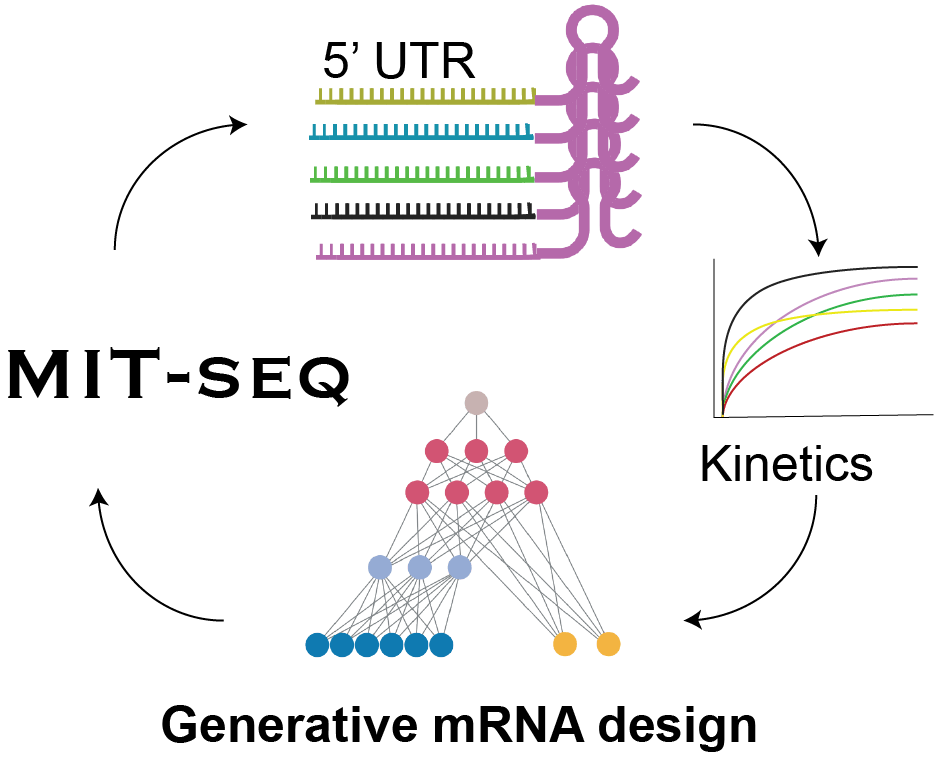
- MIT-seq: a closed loop between massively parallel kinetic measurements of mRNA translation and generative ML models for mRNA design (K99/R00 project).
- Structure-driven design rules for 5′ UTRs and ribosome binding regions in E. coli, non-model bacteria (Bacteroidetes), and human cells.
- Translation initiation modes of operons — internal vs. cap-dependent vs. re-initiation — and how to use them as engineering levers.
- Cell-free expression and modular protein synthesis platforms (a thread that goes back to our undergraduate iGEM and MSc work).
- Genetic code expansion and stop-codon suppression in E. coli and a photoautotroph.
Selected publications
- Y. Chemla et al. A possible universal role for mRNA secondary structure in bacterial translation revealed using a synthetic operon. Nature Communications, 2020. (GenScript Citation of the Year, 2021)
- Y. Chemla, F. Kaufman, M. Amiram, L. Alfonta. Expanding the genetic code of bioelectrocatalysis and biomaterials. Chemical Reviews, 2024.
- Y. Chemla, E. Ozer, I. Algov, L. Alfonta. Context effects of genetic code expansion by stop codon suppression. Curr. Opin. Chem. Biol., 2018.
- O. Schlesinger, Y. Chemla et al. Tuning of recombinant protein expression in E. coli by manipulating transcription, translation initiation rates and ncAA incorporation. ACS Synthetic Biology, 2017.
- Y. Chemla et al. Genetically expanded cell-free protein synthesis using endogenous pyrrolysyl orthogonal translation system. Biotechnol. Bioeng., 2015.
See the full list on the publications page.