Hyperspectral Biology
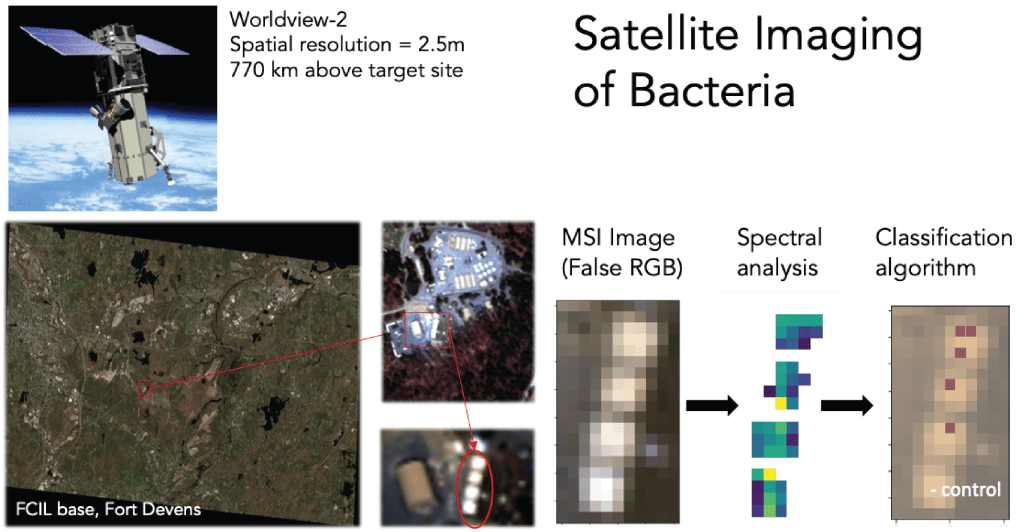
Genetically encoded reporters readable from far away — even from satellites — so we can monitor engineered cells in the real environments they live in.
Why this matters
Fluorescent proteins like GFP changed biology because we can see them. But to see them, we usually have to bring the sample to a microscope. Out in the world — soil plots, agricultural fields, contaminated industrial sites, a forest — that's not how we operate. We need reporters that report at distance: from a phone, a drone, a plane, or a satellite, across hectares and over hours, days, or years.
We are designing the next generation of genetically encoded reporters specifically for this regime: pigments and pigment-producing pathways with engineered absorbance and fluorescence signatures that survive long-range optical detection, multiplex into spectral barcodes, and decode robustly under field illumination.
What we work on
- Long-distance, wide-area reporters readable by hyperspectral cameras from drones and satellites (Nature Biotechnology, 2026).
- Spectral barcodes — engineering orthogonal absorbance signatures that can be multiplexed and unmixed.
- Field-deployable detection systems — pipelines from raw hyperspectral cube to confidence-scored gene-expression call.
- Translation to industry: the underlying technology is licensed to Fieldstone Bio (Yonatan serves as scientific advisor).
Selected publications & press
- Y. Chemla*, I. Levin*, Y. Fan, A. A. Johnson, C. W. Coley, C. A. Voigt. Hyperspectral reporters for long-distance and wide-area detection of gene expression in living bacteria. Nature Biotechnology, 2026.
- U.S. Patent 17961925 — Prediction, biosynthesis, and integration as biosensors of molecules with unique light-absorbance signatures and their in-field remote detection using hyperspectral cameras. Licensed to Fieldstone Bio.
- Plenary talks: Winter q-bio (Hawaii, 2024), Reichman Synthetic Biology (Israel, 2025), Princeton Omenn-Darling Bioengineering Institute (2025), Imperial College London (2025), UC Berkeley (2025).
See the full list on the publications page.